
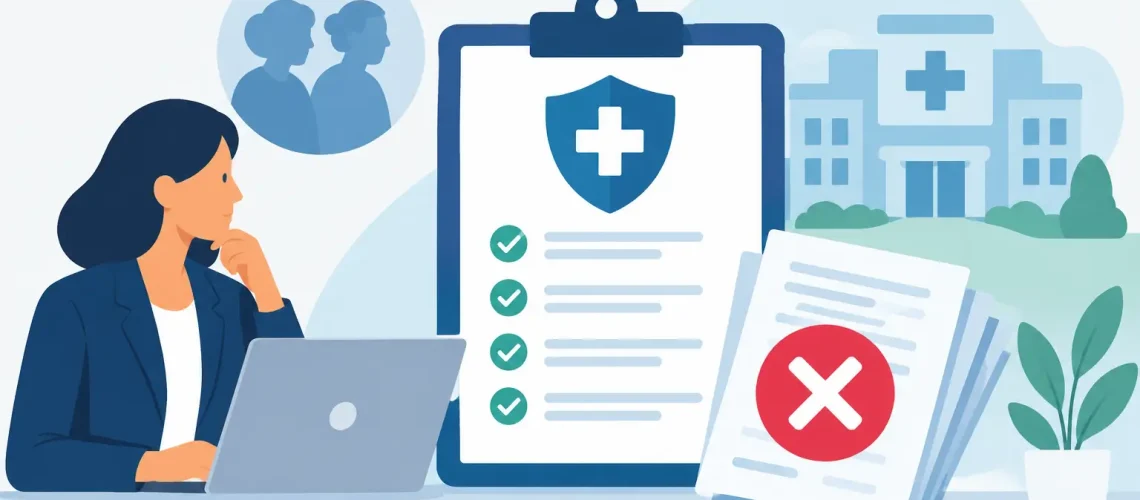
A Medicare claim can look technically clean and still create exposure. The diagnosis may be valid, the CPT code may exist, and the charge may pass claim edits, yet the service can remain vulnerable if the record does not establish medical necessity, support the level reported, or satisfy a Medicare coverage rule. Medicare compliance is not a final billing checkpoint. It is the operational discipline that connects documentation, coding, charge capture, claim submission, payment posting, and audit response.
For coding and revenue-cycle teams, the risk is rarely one dramatic error. It is usually a repeatable workflow weakness: copied-forward documentation, unsupported modifier use, diagnosis selection that does not meet a local coverage determination, or charges released before staff confirm the provider’s record supports them. Those patterns can produce denials first, then recoupments, extrapolated audit findings, or referrals for further review.
What Medicare Compliance Requires in Daily Operations
At its core, Medicare compliance means submitting claims that accurately reflect services actually furnished, are supported by the medical record, meet applicable coverage and billing requirements, and are not improperly duplicated or inflated. That standard reaches far beyond code assignment.

Coders must apply the current ICD-10-CM, CPT, and HCPCS conventions, as well as Medicare-specific instructions. Billers must submit the right claim data, observe timely filing requirements, and apply modifiers only when the documentation supports a distinct circumstance. Clinicians need documentation that explains the patient’s condition, the work performed, and why the service was reasonable and necessary. Compliance and revenue cycle leadership must test whether those pieces remain aligned after policy changes, staff turnover, EHR updates, and new service lines.
The practical point is simple: a claim is defensible only when the record tells the same story as the codes and charges. Medicare does not pay for a code in isolation. It pays for covered, medically necessary services rendered to an eligible beneficiary under the applicable rules.
Medical necessity is not a diagnosis-code exercise
A common compliance failure begins when staff treat diagnosis coding as a coverage key rather than a clinical representation of the encounter. Adding a diagnosis from a problem list may cause a claim to pass an automated edit, but it does not establish that the condition affected the service on that date.
Medical necessity must be evident in the documentation. For example, a diagnostic test may be covered for certain indications under a national coverage determination or local coverage determination. The ordering record and the performing provider’s documentation should support the indication, the test performed, and any frequency limitation. A diagnosis code that appears only on the claim, without support in the record, is not a reliable audit defense.
Teams should also remember that coverage policies vary by Medicare Administrative Contractor. A service that is payable in one jurisdiction may be subject to different diagnosis, documentation, or frequency requirements elsewhere. Organizations with multi-state operations need a process that assigns policy ownership and communicates local changes before claims are affected.
Documentation must support the level and the service
Evaluation and management services remain a high-risk area because code selection depends on the work documented, not on how complex the schedule looked or how long the provider spent in the office. Under current office and outpatient E/M rules, the level is selected based on medical decision making or total time, when time is the basis for selection. The note must support the method used.
This is where templated documentation can become a liability. A lengthy review of systems, copied physical exam, or broad problem list does not automatically establish moderate or high medical decision making. Auditors look for the problems addressed, data reviewed or analyzed, and risk of patient management. If the note does not show those elements, the level may not hold even when the code was selected in good faith.
The same principle applies to procedures and modifier use. Modifier 25 requires a significant, separately identifiable E/M service above and beyond the usual pre- or post-procedure work. Modifier 59 and the X{EPSU} modifiers require a distinct procedural circumstance, not a routine method for bypassing an edit. An edit override without clinical support may turn a short-term payment solution into a repayment issue.
Where Medicare Claims Commonly Break Down
The most persistent problems often occur at the handoffs between clinical, coding, and billing teams. Each department may complete its own task correctly while the claim as a whole remains unsupported.
Charge capture can outrun documentation. This happens when recurring charges, procedure preferences, or encounter templates generate codes before the record is complete. A charge review process should allow coders to query or hold claims when the note is missing key facts, rather than assuming the provider will amend it later.
Coding may not reflect the encounter as documented. This includes reporting conditions that were not assessed, assigning unspecified diagnoses when greater specificity is documented, or carrying forward resolved conditions. In risk adjustment settings, unsupported diagnoses create added exposure because they can affect payment beyond the individual claim.
Billing edits can create false confidence. Clean-claim status means the claim met certain electronic checks. It does not prove compliance with Medicare policy, clinical documentation requirements, or payer-specific coverage rules. Organizations should distinguish front-end edits that prevent obvious errors from retrospective auditing that tests whether paid claims are defensible.
Denial management may correct the payment but miss the cause. When teams overturn a denial through an appeal, they should ask why the claim denied initially. Was the documentation incomplete? Did registration capture the wrong coverage? Was a modifier appended without support? Did a policy update fail to reach coders? Denial recovery is valuable, but recurrence prevention is the stronger compliance control.
A Practical Medicare Compliance Control Plan
Effective oversight does not require auditing every claim at the same intensity. It requires prioritizing the services, providers, and workflows with the greatest payment and audit exposure. High-volume E/M services, incident-to billing, split or shared visits, diagnostic testing, therapy services, telehealth claims, high-cost drugs, and modifier-driven edits all deserve focused review when they apply to the organization.
Start with a written risk assessment that uses internal data. Review denial trends, payer requests, refund activity, utilization outliers, coding variance by provider, and prior audit results. A specialty practice may find its greatest risk in global surgery rules or diagnostic-test frequency limits. A hospital outpatient department may need closer attention to status indicators, packaging rules, and charge description master maintenance. The right audit plan depends on the claims the organization actually submits.
Then test claims from documentation through final billing. A useful audit should answer more than whether the code was technically permissible. It should ask whether the service was ordered when required, whether the record supports medical necessity, whether the code and modifiers accurately describe the work, whether the claim meets applicable coverage policy, and whether an overpayment process exists if an error is found.
Education should follow the findings, not generic annual training alone. If auditors identify unsupported modifier 25 use in one department, show providers and coders the specific documentation gap, the billing rule, and examples of compliant alternatives. If staff misunderstand a local coverage rule, build that requirement into charge review or claim edits where possible. Education changes behavior more effectively when it is tied to the actual claims creating risk.
Finally, measure whether corrective actions worked. Reaudit after education, monitor denial patterns, and maintain records of policy updates, training, audit results, and repayment decisions. Documentation of the compliance program will not excuse an unsupported claim, but it can demonstrate that the organization identified risk, acted on it, and monitored the outcome.
Medicare Compliance Is a Revenue Protection Function
Compliance is sometimes treated as the department that slows claims down. That view misses the operational cost of preventable denials, appeals, refunds, external audits, and provider rework. A defensible claim may take more discipline before submission, but it is usually less expensive than repairing a weak claim after payment.
The strongest organizations build compliance into ordinary workflow rather than reserving it for an annual audit. They give coders clear escalation paths, keep coverage policies current, use denial data as a risk signal, and make documentation expectations specific enough for clinicians to act on. That is how coding accuracy becomes more than a quality metric: it becomes a practical safeguard for payment integrity and patient care records.